Cell Therapy

We are dedicated to developing transformative cell therapies to improve outcomes for patients with cancer.

Cell therapy uses living cells to treat, and sometimes even cure, cancer.

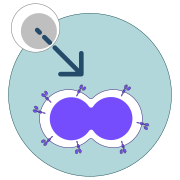
The body’s immune system can recognize cancer cells as abnormal and kill them. However, this process can fail to get rid of cancer cells entirely. Cell therapy is a type of immunotherapy to treat some types of cancer. It helps the body’s immune system find and kill cancer cells.

Patients with hematologic malignancies have already experienced the benefit of cell therapies. Our aim is to develop next-generation cell therapies that deliver patients meaningfully improved outcomes over first-generation CAR T-cell products. The successes in hematologic malignancies have not yet been achieved for patients with solid tumors, which represent approximately 90% of all cancers. We are steadfast in our commitment to bring the full potential of cell therapy to patients with solid tumors, as well as to those with hematologic malignancies.
How it Works

Treatment with CAR T-Cell Therapy 

Autologous CAR T-cell therapy is a type of personalized immunotherapy that involves taking cells from the patient, improving their functionality and cancer-fighting ability, and then transferring them back to the patient via a single intravenous infusion. These enhanced T cells can be designed with the potential to address a wide range of cancers. Unlike other cancer therapies that might require ongoing treatments, cell therapies have the potential to offer a one-time treatment option.

Treatment with a CAR T-cell therapy as part of a clinical trial generally includes the following steps.

lyell pictogram screening
Screening

Health checks such as blood tests and imaging.​

lyell pictogram collection
Cell Collection

A procedure called leukapheresis to collect some of the patient’s white blood cells.​

lyell pictogram manufacturing
Manufacturing

Modifying the cells in a lab to create the patient’s personal CAR T-cell product.​

lyell pictogram lymphodepletion
Lymphodepletion

Medications to prepare the patient’s body to receive the CAR T-cell product.

lyell pictogram singledoes
Single Dose of Cell Therapy

A single intravenous infusion of the patient’s modified T cells. This may be done in the hospital (inpatient) or in the clinic (outpatient).

lyell pictogram postmonitor
Post-Treatment Monitoring

The patient will have regular visits with their doctor, with fewer visits as time goes on. These visits help their care team check on their health and progress.​

https://www.lyell.com/wp-content/uploads/2025/12/portrait-male.webp

Our Clinical Trials

The participation of patients and their families in clinical trials enables us to evaluate our investigational product candidates for safety and efficacy. We are driven by our vision of defeating cancer and are grateful for those who choose to join us on this journey.

We are currently enrolling patients in clinical trials at leading cell therapy centers to evaluate two of our product candidates: ronde-cel (also known as LYL314), for the treatment of aggressive large B-cell lymphoma, and LYL273, for the treatment of metastatic colorectal cancer. 

These trials are assessing whether our next-generation CAR T-cell product candidates can be delivered as one-time treatments that deliver lasting remissions for patients with cancer.

Ronde-Cel

Rondecabtagene autoleucel, or ronde-cel, is designed to increase complete response rates and prolong the duration of responses as compared to the approved first-generation CD19‑targeted CAR T-cell therapies for the treatment of large B-cell lymphoma. Two clinical trials are evaluating ronde-cel in patients with relapsed and/or refractory large B-cell lymphoma.

Recruiting

PiNACLE Pivotal Trial of Ronde-Cel for Patients with Large B-Cell Lymphoma

PiNACLE is a single-arm pivotal trial evaluating ronde-cel that is enrolling patients with relapsed and/or refractory large B-cell lymphoma receiving treatment in the third- or later-line setting (disease has progressed on at least two prior lines of therapy). This trial is expected to enroll approximately 120 patients. Patients may be treated with ronde-cel in either the inpatient or outpatient setting and are required to remain near the treating center for 14 days.

RECRUITING

PiNACLE – H2H Phase 3 Trial of Ronde-Cel for Patients with Large B-Cell Lymphoma

PiNACLE – H2H is a Phase 3 head-to-head CAR T-cell therapy randomized controlled clinical trial evaluating ronde-cel versus Investigator’s choice of either lisocabtagene maraleucel, often referred to as liso-cel, or axicabtagene autoleucel, often referred to as axi-cel, in patients with relapsed or refractory large B-cell lymphoma receiving treatment in the second-line setting (disease has progressed during or after first-line therapy). The trial is expected to enroll approximately 400 patients. Patients may be treated with ronde-cel in either the inpatient or outpatient setting and are required to remain near the treating center for 14 days.


LYL273

LYL273 is designed to improve CAR T-cell expansion, immune cell infiltration into the cancer, and cancer cell killing in the hostile solid tumor microenvironment. We believe these properties are needed to improve outcomes for patients with metastatic colorectal cancer.

Recruiting

LYL273 Phase 1 Colorectal Cancer

LYL273 is in Phase 1 clinical development for patients with refractory metastatic colorectal cancer.


https://www.lyell.com/wp-content/uploads/2025/12/doctor-patient.png

Working in Partnership with Healthcare Teams

We work closely with each patient’s healthcare team to manufacture and deliver CAR T-cells with precision and predictability.

Expanded Access Policy

Lyell is committed to developing safe and effective CAR T-cell therapies for patients with cancer. Our goal is to provide our therapies to patients in a timely and clinically appropriate manner.

Additionally, cell therapies are made through highly complex manufacturing processes which Lyell performs at our LyFE Manufacturing Center™. When considering whether or not to offer expanded access of our investigational therapies (i.e., those that have not yet been approved by regulatory authorities such as the Food and Drug Administration in the United States), Lyell considers our ability and resources to ensure adequate manufacturing capacity for our ongoing clinical trials and development programs.

At this time, based on these factors and our current phase of clinical development, we currently only provide access to our investigational cell therapies to patients who have been affiliated with our clinical trials.

Under certain circumstances, individuals participating in our clinical trials may become eligible for expanded access. Should an individual wish to apply for expanded access, the individual’s clinical trial investigator should submit a request to expandedaccess@lyell.com.

Upon receiving a request, Lyell will acknowledge receipt within 5 business days and will assess:

  • The availability of satisfactory alternative therapies;
  • The sufficiency of the evidence that the potential benefit to the patient would likely outweigh the potential risks based on available safety and efficacy information;
  • Lyell’s resourcing and manufacturing capability to support our current clinical trials; and,
  • Whether granting expanded access would potentially compromise the scientific validity of broader development programs or interfere with or delay current clinical trials or regulatory filings designed to make the investigational cell therapy available to a broad patient population.

Lyell will review and respond to each request on a case-by-case basis.

The posting of this policy is not a guarantee of access to any specific investigational cell therapy by any individual patient.

If you are a patient who is interested in accessing our investigational cell therapies, please speak with your physician. You may also learn more about Lyell’s ongoing clinical trials by going to www.clinicaltrials.gov and searching for NCT05826535 and NCT07188558.

If you are a physician who is interested in learning more about our investigational cell therapies, or participating in our clinical trials, please submit a request to clinicaltrials@lyell.com and our team will respond as soon as possible.

Our Science

Learn about our novel approach to developing next-generation CAR T-cell therapies.